Hi all
New user of vassal here
Does anyone have any recommendations for the best war games on vassal
Also am interested in operation Barbarossa so at the same time would appreciate recommendations on eastern front war games
Thank you
Hi all
New user of vassal here
Does anyone have any recommendations for the best war games on vassal
Also am interested in operation Barbarossa so at the same time would appreciate recommendations on eastern front war games
Thank you
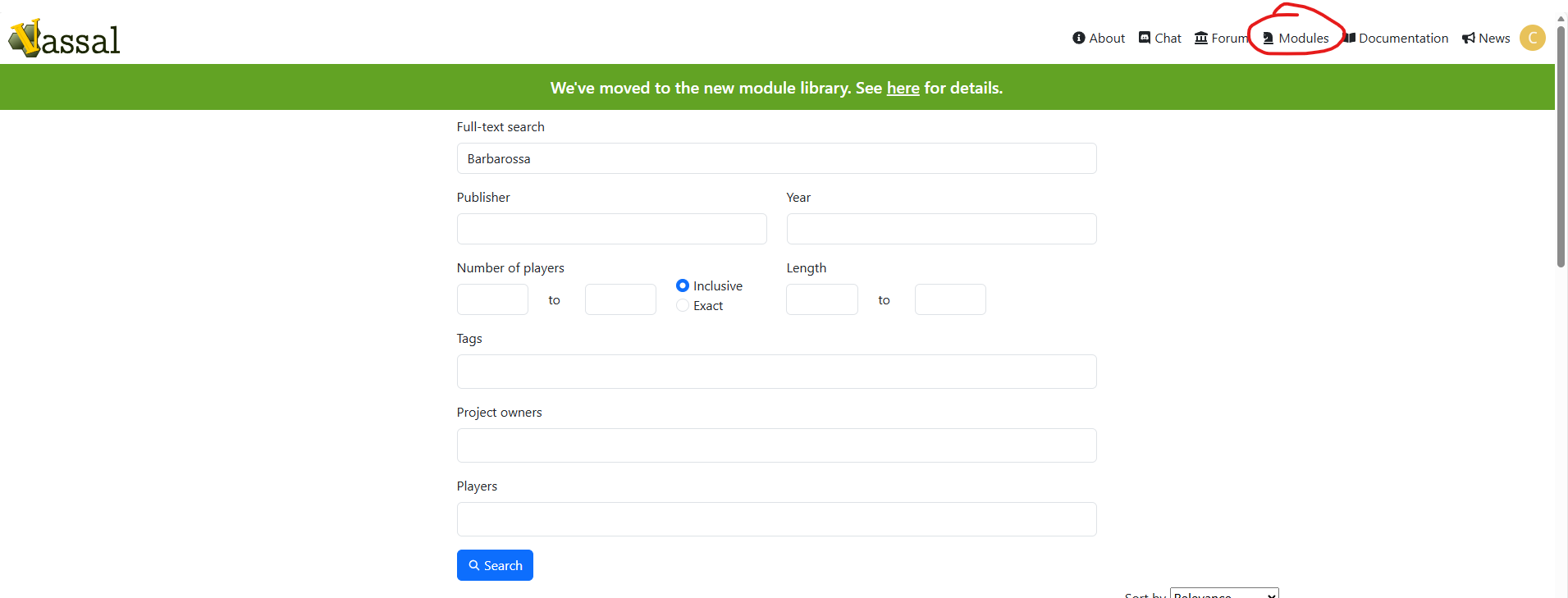
Click on the Modules Library then click on the Filters icon. Then…
type “Barbarossa” into the Full Text Search Field and all of the Barbarossa related modules will be listed.
If you want an introductory wargame on the Eastern front, which in its Vassal implementation provides a fair bit of automation, I would recommend

To me, the quintessential Barberrosa and larger eastern front game is
You can also do a tag search like
Yours,
Christian
To be clear you are expected to physically own the game you are playing on vassal. The game companies have mostly allowed vassal modules to be posted for use, it is very important that we do not abuse that privilage!
In some cases, that is true, if the owner of the copyrighted materials has slapped that condition on the license of use.
I would recommend anyone to read this thread over on BoardGameGeek.
The TL;DR of that thread is
GMT’s conditions on Vassal (and similar) modules, can be found in their FAQ (at the very bottom). It says that at least one player must own a physical copy, but that “rules, playbooks, player aids, or other game-related content” may be photo-copied (no word on electronic copies) for non-commercial and personal use.
L2’s webpage has since August 2019 said “We will be OFFLINE for a few weeks UPGRADING THE NEW SITE!”, so no clue there.
Other publishers are often not very explicit about the license to their copyrighted materials. Decision Games, for example, provide their own Google Drive folders of Vassal modules and rules. The do not, however, stipulate under which conditions the copyrighted materials can be used.
If other publishers allow their copyrighted materials to be used in a Vassal module, without owning a physical copy of the game, then it is perfectly OK to use the module without owning a physical copy.
It would actually be a good idea if module authors would be more explicit about the license under which the copyrighted material is used. Without an explicit license, any redistribution of copyrighted materials is prohibited. For example, all modules of GMT games should probably either reproduce the last question of their FAQ or give a link to it.
Of course, what can be copyrighted is limited - and does not include things like game mechanics, rules, systems, and the like.
You can make a game that functions exactly like Monopoly iff you do not use any of the graphics or copy the rules verbatim - in full or in part. You cannot call it Monopoly because that is a trademark of Hasbro, nor are you likely permitted to use the name Monopoly anywhere in your game or promotions of the game, as that would infringe on the trademark, and because Hasbro has actively upheld that trademark.
Scans of graphics - such as maps and counters, or verbatim copies of rules, as posted on for example BGG, could be copyright infringements, as could any module which contains such things without license.
My 2¢
Yours,
Christian
Added to all that is the difficulty, if not impossibility, of actually enforcing any copyrights.
Permission or no permission, anyone can scan an entire boardgame for their own personal use, and everyone would be none the wiser to it. A person could even privately share a digital version of a boardgame they made with their friends. The key word there is “privately”, opposed to publicly sharing, such as by uploading a digital version to a publicly accessible website, like vassal.org. That’s about the only thing that can realistically be enforced, the prohibition to post a digital version publicly.
Everything else is mostly hubris and virtue signaling, like, “Hey, I wanna make a Vassal module of this game, but I want to police myself in my own home and on my own computer and not violate anyone’s 50-year-old real or imagined copyrights. Like, I’m really and deeply concerned about that. Also, there’s a guy on eBay selling CD’s of all the old General Magazine issues. People like that should go to jail. Like, yeah.”
I’m not trying to be a nasty person here. I’m just relating what the reality is.
To be clear, it is still copyright infringement to share copyrighted materials - whether it is on a publicly accessible platform or not. True, it will be hard to litigate.
If your livelihood is contingent on upholding copyright, then it is understandable that you would care about copyright - a certain drummer comes to mind. It would be hypocritical to claim one cares about ones own copyright while at the same time sharing others copyrighted materials without license.
It’s a little like saying I want free healthcare but I don’t want to pay taxes.
Copyright does generally not expire until 70 years after the initial release.
One is free to create a copy of copyrighted material for ones personal use, but if you somehow want to share it - whether publicly or privately - you will need some sort of license to do so. Thus, if you want to share a Vassal module that contains copyrighted materials - graphics, phrasing of rules - and you do not own that copyright, then you must have license to do so. If not, then you a liable and the hosting service - e.g., vassalengine.org - may likewise also be.
Granted, many publishers seem to take a relaxed attitude towards this - e.g., GMT and Decision Games, and Compass Games actively promote third-party modules with their copyrighted materials in it. However, that wasn’t always the case - Decision Games blocked Vassal modules with their copyrighted materials in them for a long time, and I know of several game authors that have objected to their game being made available, some even threatening with lawsuits - even if the proposed module did not contain copyright-able materials.
One way around that is to not use third-party copyrighted materials in your modules. Since rules, mechanisms, systems, etc. are not copyright-able - not creative expressions - that is doable. Then, one can slap on a license that allows anyone else to use it as they see fit.
The point is, that the issue isn’t entirely “academical” or a question of “virtue signaling”.
One could argue that that guy should go to jail for exploiting the vulnerable, when you can find the same scans elsewhere - and archived - for free
Well, one could argue that you didn’t quite succeed But, no worries.
Yours,
Christian
I am merely pointing out that no one has control over what people do in the privacy of their homes. If someone wants to make a digital version of a game, Vassal (and other similar programs) provides the tools do so and no one can stop them. Therefore, for most if not all intents and purposes, trying to enforce a copyright under those conditions is all but impossible.
Similarly and for the same reason(s), no one has control over what people share, privately, with their friends.
This isn’t rocket science.
I’m not advocating violating anyone’s copyrights, I’m not encouraging it, I’m not even condoning it. I am merely pointing out the reality that enforcement of copyrights in this so-called “industry” is realistically only possible in the public realm.
My understanding when I started using vassal was that they wanted that standard kept to keep game companies happy.
I think no one disagreed with your characterisation of how difficult it can be to litigate copyright - I certainly didn’t. Also, no one suggested you endorse - in any way - breaking copyright law.
What I did object to was your rather snarky and possibly condescending characterisation of people who may care about copyright - for various good reasons - be it because it is in their interest to uphold their livelihood, respect other peoples work, or because they want to be able to share their work without bringing anyone into trouble.
I do agree with you that there’s a lot of “imagined copyrights” - which is why I brought up this thread over on BoardGameGeek.
In the context of Vassal - and in particular the module library - it would be a good idea to be specific about under which conditions the materials are distributed. If for no other reason than to protect Vassal from liability.
That could have been the case, but nowhere is it stated to day (except on GMT’s page). In fact, the wording of Decision Games’ stance does not say anything along those lines. If it is a requirement to use a specific module, then the module project should specify that.
Yours,
Christian
Discussions of the nuances of copyright are seldom productive, as they tend to be conducted with no reference to jurisdiction by people who are not copyright lawyers. These discussions are best held elsewhere.
Stalingrad 42
Using vassal is a privilege that we could only have dreamed about back in the snail mail days! So to protect it and the game companies who produce games I buy a game before I do a vassal module for it and I ask the company or owners permission before doing the work. Had to work with the APBA owner for almost 3 months before getting his permission to create Saddle Racing module.
The extra work is worth protecting it!
The following applies only for the United States.
Only if you’re publishing (distributing for commercial purposes) if I understand the stated purpose of copyright law and court decisions of the last couple of decades properly.
Copyright law was VERY meaningful when the cost of typesetting a page of type was much more expensive then making a lithographic copy and then selling, say, books of literall pages literally duplicated from the original publisher. As the cost of initial production is dropping by orders of magnitude, the value of copyright is dropping accordingly. Also, it was never meant to “protect” a work that the copyright holder themselves doesn’t even bother to offer for sale any more, as the mere failure to continue providing the product means that they consider the copyrighted work to be no longer monetarily viable. At which point, any enforcement action on copyright of a product which the copyright holder REFUSES to produce and sell is just vindictive, and the lack of offering for sale indicates that the copyright holder does not actually suffer any lost sales for a product they aren’t even offering.
In contrast, Sweden doesn’t care what you do with stuff that isn’t copyrighted in Sweden.
Not true.
Both the USA and Sweden has ratified the Berne Convention for the Protection of Literary and Artistic Works and are thus obligated to respect copyright claims across whole set of nations that are party to that convention. Most nations has ratified that treaty, with some notable exceptions.
The Napster case would be a counter example to that assertion.
There’s no provision in copyright law that implies that a no-longer-available work is no longer copyrighted, beyond the age of expiration (typically 50 years).
I suggest you go an read this thread over on BoardGameGeek which explains things quite well.
Yours,
Christian
Decision Games stance seems to be encapsulated in their dg-vassal page. On the 24th of March 2014, they write
At the same, we announced anyone could make VASSAL modules and post them as they pleased.
and later, on the 1st of May, the same year, they affirm that stance
- Nothing is changing in DG’s ongoing commitment to allow the creation of VASSAL modules by individual users.
So what DG seems to be saying, is that any one can make any module of their copyrighted material, and distribute it as they see fit - with one caveat (also 1st of May, 2014):
- … Therefore, DG will not be licensing its copyrights or artwork for the creation of VASSAL modules for sale.
Thus, one cannot sell the modules.
In short, it seems we are free to create modules of DG (and SPI) games and distribute those, as long as we do not charge for it.
Yours,
Christian
By black letter law, discontinuation of availability for sale of copyright owner’s holding doesn’t eliminate the copyright… but no copyright holder can go into court claiming injury on the unauthorized copying of a work which they no longer provide for sale.
Since copyright infringement is civil, not criminal, a demonstration of damages is required of the plaintiffs to get a judgement in their favor. A copyright holder can’t claim lost sales for a work which they won’t provide for sale (even if the logic is – the cost of set-up and restarting production is $100,000, and the demand for the work would result in $500 in sales – to provide the work would result in a loss of $99,500).
The purpose of copyright was always, since the beginning of the concept, rooted in commercial interest for the copyright holder to economically exploit a temporary monopoly, by protecting them from other commercial publishers from taking a a copy of something which was expensive to set up (typeset books optionally with illustrations created by engraving, woodcut, or lithography process(es)), and making copies of that work without having to put in nearly as much effort as the original publisher. That is until Walt Disney decided that the company should fight relentlessly to keep “Steamboat Willy” under copyright protection in perpetuity, or as close to that as they can bribe Congress into going along with. The US Constitution says that creations of inventors’ and artists should be protected for “limited periods of time.” There is absolutely zero reason to believe that they meant that copyrighted works could or should potentially be under (monopoly) copyright protection for over 100 years (such as say, a 20 year old musician recording a record under contract with a record company, which has produced the recording as a “work for hire” (so that said musician himself never owned the copyright for even a second, even though the ENTIRE THING depends on his performance), who say, then lives to the age of 80 (so 60 years under copyright) and then another 50 years on top of that to be 110 years… long after even his descendants don’t even know his name. An indeterminate amount of time, which could well be 100+ years of copyright protection flies directly in the face of the phrase “for limited periods of time,” as well as the patent and copyright laws in Europe upon which the US Patent and Copyright laws are based (yes, I know about centuries long “livery patents” which is to say trademarks. Trademarks are indeed unlimited in duration in U.S. law, but those are more akin to commercial identifiers related to company names, not products being invented and/or created by those companies.
Also, with respect to vassal – games cannot be patented (although portions of the contraption used in the game “Mouse Trap” by Ideal Corp. (since purchased by.. ugh…Hasbro), might have been eligible for patent protection when the game was first designed in the 1960’s.
Napster’s problem was that they were doing something which made a case for the copyright holders to claim SIGNIFICANT loss of sales, AND Napster was charging money. IF Napster had been doing everything for free, the chances of getting a judgement in their favor would have been significantly lower (again, the theory of legal copyright is primarily about commercial publishers preventing other COMMERCIAL publishers (whether large or small) from putting out competing works. Copyright law has never targetted non-commercial copying. All of the exceptions (transformational work, excerpts for education or criticism, etc.) themselves presume that those exceptions are needed OTHER commercial activities to have legal routes of some forms of copying an selling copyrighted works.
Hasbro bought Avalon Hill. The ONLY titles from Avalon Hill that they have continued to provide is Axis and Allies and Diplomacy**, and sold off Advanced Squad Leader to Multiman Publishing (MMP). The rest they have just acted as if they don’t even exist.
In Contrast, Decision Games bought up all of SPIs (Simulations Publications, Inc) copyrighted works, and has endeavored to provide as many of those works on the commercial market as quickly as they can.
Thus, in two otherwise identical infringement cases, Decision Games would have a MUCH more valid complaint of infringement on an old SPI title than Hasbro has on ANY Avalon Hill game outside of A&A and Diplomacy, because DG is showing an intent to bring back as much of the old SPI line as possible, while Hasbro has shown zero interest in doing so.
** which, in true Hasbro fashion, they immediately turned both games into a “pieces of injection-molded plastic” game which was more than adequately executed with printed die-cut chipboard counters, which are easily replaced by the owner if one gets lost without disrupting the visual processing of the game state by players, whereas replacing a piece of injection molded plastic is going to be more difficult, and the resulting replacement far less likely to fit into the game without either calling attention to itself, or conversely, being frequently missed by the pattern-recognition center(s) of one or more participants.
You do not need to show injury - financial or otherwise - to succeed in a copyright infringement case. Only that the materials was copied illegally.
It is usually decided as a civil matter, but can be elevated to a criminal matter in some circumstances.
Arguments about financial losses, or similar are not really relevant to establish copyright infringement. A judgement can punitive in other ways than financially - such as stopping distribution or the like.
I think you are conflating copyright with patents. I reiterate:
DG and AH (which still exists as subsidiary of Hasbro) could, if they wanted to, equally well try to enforce older copyrights. They would not need to show any potential losses - only that the materials were copied without license. If a publisher decides to not publish a book, it does not mean that the manuscript becomes public domain. If a painter does not re-paint a painting, it does not mean that it becomes public domain. The painter can still claim copyright on the painting, and other parties are not free to copy it, nor create derived works from it (there are plenty of cases that illustrates that).
If you read the Wikipedia article on the Berne Convention for the Protection of Literary and Artistic Works it is quite clear that financial considerations are not at the heart of the problem - rather, it is the right to ones own work, and what ever exploitation - financial or otherwise - of that work, which is concern.
If copyright law (and conventions and treaties) was not concerned with non-commercial copying, derivative works, etc., then anyone could copy a book, a piece of music, a painting, etc., in full, and give it away for free, legally. Clearly, that is not the case (and no, the USA fair use exception doesn’t allow that either). If that was the case, I could copy Enter Sandman on to some web-server and give it away for free, and Metallica would have no recourse. Or, I could get a band together, record the song, and then give it away for free, and still Metallica would have no claim.
Yours,
Christian